
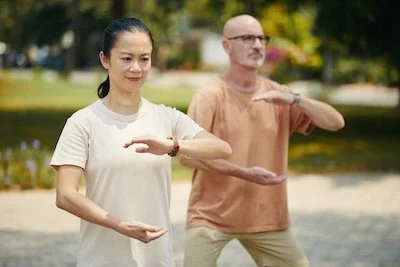
What Is Qigong Practice?
by Christopher Grant, Great Energy
Benefits, Meditation, and How to Begin
Qigong, pronounced chee-gong, is a gentle yet powerful movement and meditation practice that has supported healing and vitality for thousands of years.
At its core, Qigong is the practice of working skillfully with your life energy. Through slow movement, conscious breathing, and focused awareness, you help the body restore balance and the nervous system return to regulation.
If you are looking for a deeper historical and technical definition, see our What Is Qigong? Definition, History, and How It Works page.
This guide focuses on the lived experience of practice.
What Is Qigong in Practical Terms?
Qigong brings you home to your body.
The movements are often slow and circular. The breath is relaxed and steady. Attention rests gently inside sensation rather than racing outward.
When practiced consistently, Qigong becomes less about choreography and more about rhythm. It helps you feel your energy instead of chasing it.
Many students describe it as medicine in motion.
What Are the Benefits of Qigong Exercises?
People practice Qigong for one simple reason. It helps them feel better.
With regular practice, Qigong may support:
Nervous system regulation
Improved balance and mobility
Better sleep quality
Reduced stress and anxiety
Greater emotional clarity
Support for chronic fatigue and autoimmune conditions
Stronger immune and respiratory function
Modern research supports improvements in stress markers, inflammation, balance, and overall quality of life.
If you are interested in how Qigong influences the stress response directly, you may also enjoy our article on Have You Ever Tried to Think Your Way to Calm?
Qigong works because it addresses the body and mind at the same time.
If you’re curious about the physical changes people experience from regular practice, see What Does Qigong Do for the Body?
What Is Qigong Meditation?
Qigong is not only movement. It is also meditation.
In Qigong meditation, you use breath, visualization, stillness, and awareness to guide energy through the body.
There are two primary expressions:
Active Qigong - Movement-based practices that build energy and vitality.
Passive Qigong - Still practices that calm and nourish from within.
Both are accessible. Both are effective. Both can be practiced regardless of age or physical condition.
Qigong vs Tai Chi
Tai Chi developed as a martial art with long choreographed sequences and self-defense applications.
Qigong is typically simpler and more adaptable. It emphasizes energy cultivation and healing rather than memorized forms.
Because of its flexibility, Qigong is often easier for beginners and those recovering from illness or injury.
Qigong vs Yoga
Yoga emerges from the Indian Ayurvedic and yogic traditions. Qigong arises from Chinese medicine and Taoist philosophy.
Both integrate breath and movement. Qigong tends to use softer, circular motions and places strong emphasis on energy flow through meridians.
For a deeper comparison, visit our Qigong vs Yoga guide.
How to Start Practicing Qigong as a Beginner
You do not need equipment or special clothing.
Begin with five to fifteen minutes.
Stand comfortably.
Relax your shoulders.
Breathe slowly through your nose.
Let the exhale be slightly longer than the inhale.
Move gently and without force.
Consistency matters more than complexity.
Many students begin with structured beginner guidance such as our Jump Start Your Energy free class, or through foundational training like Beginning Healing Qigong.
What matters most is showing up and allowing the body to remember its natural rhythm.
Is Daily Qigong Practice Right for You?
Qigong may be especially supportive if you are:
Longing for more vitality and steadiness
Healing from burnout or chronic stress
Managing fatigue or autoimmune symptoms
Seeking a gentle but structured practice
Wanting to reconnect with your body in a grounded way
You do not need to be flexible.
You do not need prior experience.
You do not need to identify as spiritual.
You only need curiosity and a willingness to move slowly.
Those who wish to deepen their study for personal or professional reasons can explore structured programs such as our Great Energy Healing Qigong Immersion and Teacher Certification.
“Qigong begins simply - Presence in motion - it only takes 15 minutes a day to get started”
~ Christopher
References
National Center for Complementary and Integrative Health. Tai Chi and Qigong: What You Need to Know. Updated 2024.
Jahnke R., Larkey L., Rogers C., Etnier J., Lin F. A Comprehensive Review of Health Benefits of Qigong and Tai Chi. American Journal of Health Promotion.
Chan J. et al. Effects of Qigong Exercise on Anxiety and Depression. Complementary Therapies in Medicine.