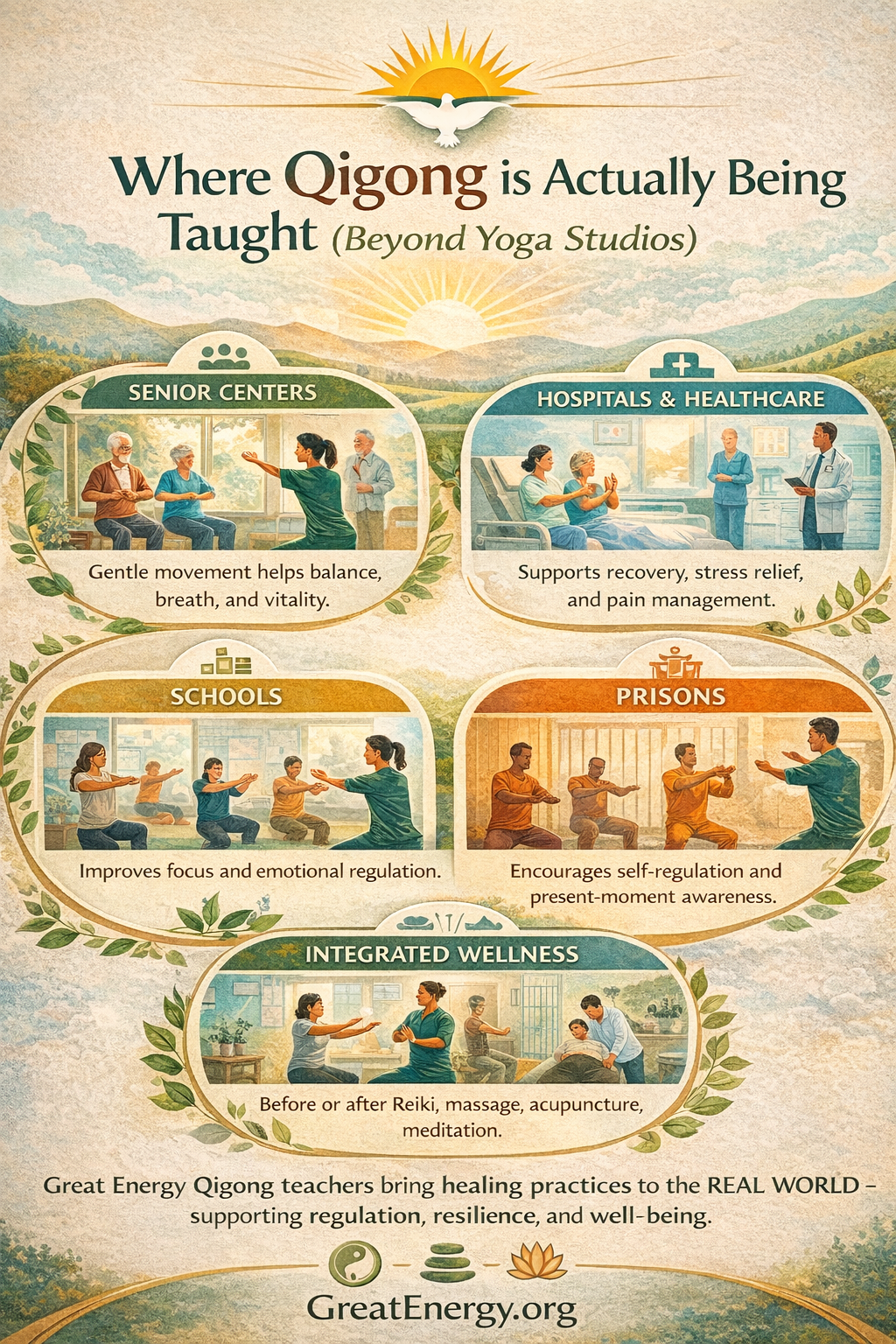
Where Qigong Is Actually Being Taught Today - Beyond Yoga Studios and Gyms

When people hear the phrase Qigong teacher, they may imagine a yoga studio or a gym.
That image doesn’t reflect reality.
Most Great Energy Qigong graduates are not teaching in yoga studios. They’re teaching in society. They’re bringing Qigong into real human environments where regulation, presence, and energy matter far more than flexibility, performance, or aesthetics.
Many people searching for qigong teacher training or qigong certification assume the path leads to a studio or gym model. In reality, Qigong is being taught across healthcare, education, community programs, and integrated healing settings throughout the United States and Canada.
Qigong is not a location-based career, It is a transferable skill.
And that distinction changes everything.
Qigong as a Portable Practice in Modern Society
Qigong does not require mirrors, mats, music systems, or athletic bodies. It does not depend on a particular room, schedule, or demographic. It can be practiced standing, seated, or lying down. It can be taught one-on-one or in groups. It adapts to the person and the environment, rather than asking the person to adapt to the practice.
This adaptability is why Qigong is used in medical qigong training, community wellness programs, and professional environments where traditional movement practices are either inaccessible or inappropriate.
In modern North American society, this matters. People are aging. Stress levels are high. Nervous systems are overloaded. Many individuals need support that is gentle, grounding, and effective without being physically demanding.
Qigong meets those realities directly.
Where Great Energy Qigong Teachers Are Working Today
Great Energy Qigong teachers work in places where real people live their lives. They teach where regulation, resilience, and embodied presence are needed most.
Qigong in Senior Centers and Aging Communities
Many Great Energy graduates teach Qigong with older adults. Not as exercise, but as a way to support balance, circulation, breath, and nervous system stability. Movements are subtle. Awareness becomes the anchor. Confidence in the body is gradually restored.
Qigong offers aging populations a way to stay connected to vitality without strain. Practices can be adapted for mobility limitations and done seated or standing. This work supports fall prevention, emotional well-being, and quality of life.
Qigong in Hospitals and Healthcare Settings
Qigong is increasingly recognized as a supportive practice within healthcare environments. Graduates teach Qigong to support stress reduction, recovery, pain management, and nervous system regulation.
This is one reason medical qigong certification programs and hospital-based Qigong initiatives are gaining traction across North America. Qigong complements medical care by addressing the physiological stress that often accompanies illness, treatment, and recovery.
This is not alternative medicine, it is nervous system support.
Qigong in Schools and Educational Environments
In schools, Qigong becomes a tool for regulation. Teachers and facilitators use Qigong to help students settle their bodies, improve focus, and regulate emotional responses.
Modern educational environments are often overstimulating and demanding. Qigong meets students where they are, offering simple, embodied ways to return to balance without requiring silence, perfection, or prior experience.
Qigong in Prisons and Correctional Facilities
One of the most powerful applications of Qigong is in correctional settings. In prisons, Qigong supports grounding, emotional containment, and self-regulation for individuals living in high-stress, high-control environments.
Qigong offers something rare in these settings – a way to experience internal stability regardless of external conditions. The work is quiet, respectful, and deeply relevant.
Qigong in Integrated Wellness and Healing Practices
Many Great Energy graduates incorporate Qigong into existing practices rather than replacing them. Qigong is taught before Reiki sessions, before or after acupuncture, alongside massage therapy, and as preparation for meditation or somatic work.
In these settings, Qigong enhances the effectiveness of other modalities by preparing the nervous system and body to receive care. It becomes a bridge rather than a competing discipline.
Why Qigong Is Relevant in the US and Canada Today
Across the United States and Canada, people are navigating chronic stress, burnout, healthcare overload, aging populations, trauma exposure, and widespread nervous system dysregulation.
Qigong does not attempt to solve these issues conceptually. It works at the level where change actually occurs – the internal state of the body.
This is why Qigong remains relevant across generations, professions, and social contexts. It addresses something universal: the need for regulation, resilience, and sustainable energy.
Qigong Is Not a Studio Career - It’s a Transferable Skill Set
Becoming a Qigong teacher does not mean adopting a narrow career identity. It means developing a skill set that integrates into healthcare, education, community service, spiritual care, and existing wellness professions.
For many people exploring qigong instructor training or qi gong certification, the goal is not a studio schedule. The goal is usefulness. Adaptability. Relevance.
Great Energy graduates are often midlife professionals, healers, educators, and caregivers. They want something that can be woven into the work they are already doing, rather than something that replaces it.
Qigong allows that.
How Great Energy Qigong Training Prepares Teachers for the Real World
Great Energy Qigong is not designed to produce performers or studio-dependent instructors. It is designed to train people who can work skillfully with real humans in real environments.
The training emphasizes nervous system awareness, trauma-informed teaching, adaptability, simplicity, and embodied presence. Graduates leave prepared to teach Qigong in hospitals, schools, senior centers, correctional facilities, and integrated wellness settings - not just in idealized spaces.
Great Energy offers qigong training online that reflects how Qigong is actually used in society today.
Why This Matters Now
In the United States and Canada, people are navigating a convergence of challenges that aren’t abstract - chronic stress, burnout, aging populations, healthcare strain, trauma exposure, and nervous system overload. These realities are already shaping daily life in schools, hospitals, communities, and institutions.
Qigong meets this moment not because it is trendy or ancient, but because it is adaptable. It works with the body as it is. It supports regulation rather than performance. It can be offered quietly, respectfully, and effectively in places where people actually live and work.
This is why Qigong does not belong on the margins of society. It belongs within it – as a practical, human practice that supports resilience, presence, and sustainable energy in real-world conditions.
Qigong in Society, Not on a Pedestal
Qigong does not belong behind glass or inside rigid frameworks. It belongs in the places where people are living, struggling, aging, healing, and growing.
That is where Great Energy Qigong lives.
And that is why it continues to matter.
Author Context
This article reflects decades of teaching experience and the lived work of Great Energy Qigong graduates across the United States and Canada. It is grounded in real-world application rather than theoretical models or gym- and studio-based assumptions.