
Shaking for Anxiety: The 60-Second Practice That Actually Works
The SUNY Morrisville Volunteer Opportunity
Yesterday, Daniela and I drove to SUNY Morrisville to speak to a room full of college students and their healthcare providers.
The topic was anxiety. What it looks like on campuses right now. What students actually carry around all day in their nervous systems. And what they can do about it - not someday, not after therapy, not after figuring it all out. Right now. In sixty seconds.
The practice we taught them was shaking.
By the end of the session, the room was different. I don't know how else to say it. Students who walked in with that tight, held-in, trying-not-to-look-anxious energy walked out looser. A few of them stood there for a moment after we stopped, eyes a little wide, like they'd just discovered something they couldn't quite name.
That's what nervous system regulation actually feels like when it happens in your body instead of on a worksheet.
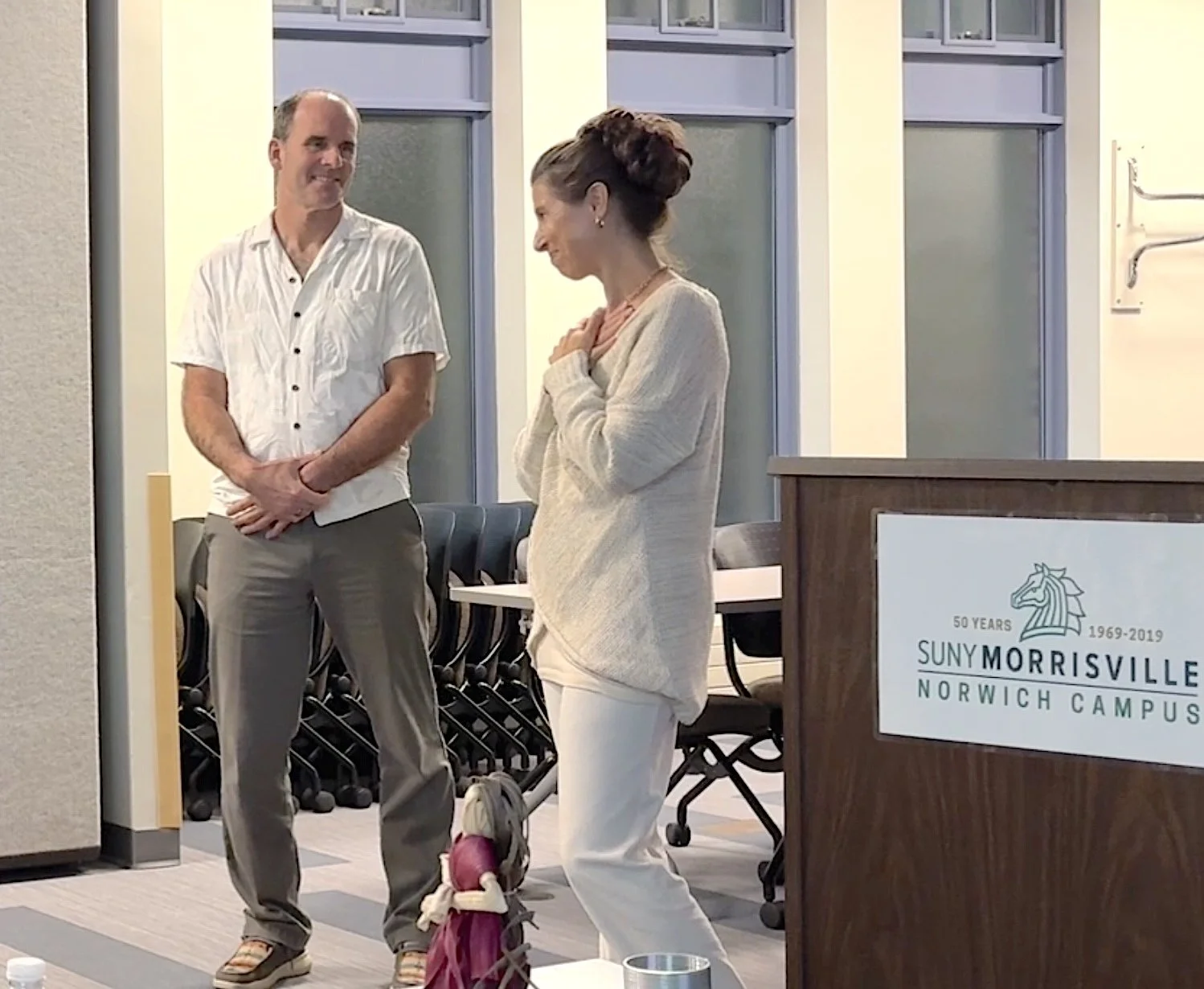
Christopher Grant & Daniela Hess
Teaching about Anxiety and Great Energy Qigong at Suny Morrissville, Norwich NY.
Why Shaking Works for Anxiety (The Science)
The science is not complicated, but it is real.
Shaking releases tension from the muscles. Releasing tension from the muscles releases tension from the nervous system. Stephen Porges' Polyvagal Theory explains the mechanism: the nervous system is constantly scanning for safety, and chronic tension is one of the ways it signals threat. When you shake, you discharge that stored activation and return the system to a state of calm.
This is also the foundational insight behind TRE - Tension and Trauma Releasing Exercises, developed by Dr. David Berceli - which uses therapeutic tremoring to release deep muscular tension held in the body. What we teach in Great Energy Qigong draws from the same understanding: the body holds what the mind can't always access, and movement is how you let it go.
Peter Levine documented this beautifully in Waking the Tiger. Animals in the wild shake instinctively after any stressful encounter. A gazelle that barely escapes a lion doesn't replay what happened. It shakes - violently, full body - for about thirty seconds. And then it goes right back to grazing, completely calm.
That's not a metaphor. That's how nervous systems are designed to work.
We've just forgotten how. Somewhere along the way, we decided shaking was embarrassing. That losing control of your body, even for a minute, even on purpose, was not something composed adults do. So instead, we carry it. We hold the jaw tight. We lift the shoulders. We brace. We get through the day.
Then we wonder why anxiety is everywhere.
What Happened When We Taught It to College Students
I watched students at SUNY Morrisville on April 30, 2026, shake for sixty seconds and then stand completely still, genuinely surprised by how good they felt. These are students who'd never heard of Qigong, who came to a campus presentation on anxiety expecting handouts and hotline numbers. They didn't expect to shake.
But their bodies knew exactly what to do.
That's the thing about somatic anxiety relief - it doesn't require belief. It doesn't require you to be spiritual, or experienced, or even fully on board. You just have to try it once and feel it work.
How to Do the Shaking Practice
Stand with your feet a little wider than hip-width. Bend the knees slightly. Let the shoulders drop. And shake. Let your arms be loose - noodle arms. Bounce. Let your jaw relax.
Do this for sixty seconds.
Then stop. Stand still. And just notice.
You might feel tingling. Warmth. A gentle buzzing. Your cells might feel like they just woke up.
That's your nervous system releasing what it's been carrying - the stressful moments, the unfinished conversations, the low-grade worry running in the background like software you forgot to close.
I've been doing this for over twenty years as part of my Great Energy Qigong practice. It's the one thing I would never give up. Not because it's complicated or requires anything special. Because it works. Immediately. Every time. For almost everyone who tries it.
Try It Right Now
Stand up. Feet a little wider than hip-width. Knees slightly bent. Shoulders dropped. Shake. Noodle arms. Loose jaw. Sixty seconds.
Then stop and notice.
If you want to go deeper, this 14-minute "Magic 5" morning routine is where I'd send anyone just starting out. It's what I do myself, and it's what I recommend for anyone who wants a daily qigong practice for anxiety and energy:
🔗 Qigong Morning 'Magic 5' for Beginners
One minute. That's all I'm asking.
Try it and tell me what you noticed.
- Christopher
Christopher Grant is a qigong teacher and co-founder of Great Energy, where he teaches live online classes in Great Energy Qigong for nervous system regulation, energy cultivation, and whole-body health. Classes are open to all levels and meet weekly. They also offer a well-regarded Qigong Certification.