
AI Marketing Tools for Wellness Practitioners: A Practical Guide for Yoga Teachers, Qigong Teachers, Coaches, and Healers
by Christopher Grant, Great Energy
AI Marketing Tools for Wellness Practitioners: A Practical Guide for Yoga Teachers, Qigong Teachers, Coaches, and Healers
By Christopher Grant, co-founder of Great Energy - May 2026
The 60-second answer
If you teach yoga, Qigong, meditation, or any movement or healing practice, run a coaching or counseling practice, or work in massage, Reiki, or somatic therapy, AI can take hours of marketing work off your plate every week. Done well, it sounds exactly like you and brings your real voice to more people. Done poorly, it sounds like every other LinkedIn post on earth. The difference is not the tool. The difference is whether you're using AI or training it. This guide walks you through the practical shift.
The article you didn't expect from a Qigong teacher
A friend of mine, a yoga teacher I love and trust, sent me a message last month. She said: "Christopher, can you talk to me about AI? I've been resisting it. It feels gross. But everyone keeps telling me I'm being left behind, and I'm starting to wonder."
I get some version of this question almost every week now. From yoga teachers, from Qigong teachers, from coaches, from massage therapists, from somatic practitioners and Reiki practitioners and counselors and grief workers.
The fear underneath the question is usually the same one. If I let AI into my work, will I lose what makes my work mine?
It's a fair fear. I had it too. Daniela had it too. We're a healing and education business. Our voice is the medicine. If the medicine gets flattened on the way to the student, we've failed at our job, no matter how many emails we sent or posts we made.
So we sat with it. We tried it. We resisted it, then tried it again. And what we found, in the time we've been building this into how Great Energy actually runs, is that AI isn't going to flatten your voice. Not knowing how to train it will flatten your voice.
This article is the version of that conversation I wish I'd had earlier. We use these techniques every day in our own business, and we now build them for clients in our industry. Here's the practical, marketing-focused version, with the parts that matter most for people doing the kind of work we do.
The mistake almost everyone makes the first time
You open ChatGPT or Claude. You type something like:
"Write me a blog post about morning Qigong practice in my voice."
You hit enter. Out comes a wall of text. It's grammatical. It's vaguely on topic. And it sounds nothing like you.
You read it back and feel a small crash inside. You think, I knew it. AI is cold. AI doesn't get me. You close the tab. You go back to writing your own emails at 9pm on a Sunday because nobody else can do it the way you can.
This is what almost everyone does the first time. It's also why so many wellness practitioners write off AI as not for them.
Here's what's actually happening. You handed AI a tool, an empty room, and no information about you, your students, your teaching, your voice, or what you're trying to do. Then you asked it to sound like you. Of course it didn't. A new staff member you handed the same prompt to wouldn't sound like you on day one either. It would take them six months of working alongside you to start writing in your voice. It might take a year before they got it right.
AI is the same. The output is only as good as what you've taught it.
This is the shift you have to make. Stop using AI. Start training it.
Using AI vs. training AI: a side-by-side
Here's what the difference actually looks like in practice, on the dimensions that matter most for a small wellness business:
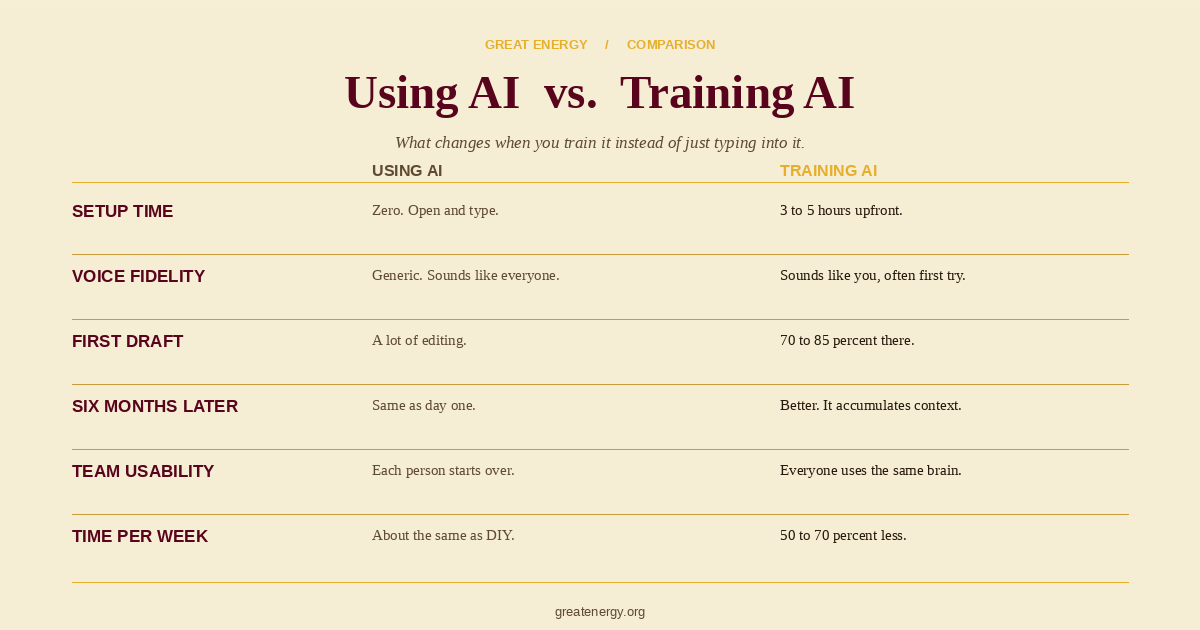
The middle column is what most practitioners are doing right now. The right column is what we'd help you build, and what this article walks you through.
What "training AI" actually means
Training AI sounds technical. It is not. You don't need to code. You don't need to know what an API is. You don't need a developer.
What you need is the willingness to do for AI what you'd do for a new apprentice teacher: tell it who you are, show it your work, give it your reference materials, correct it when it gets things wrong, and let it watch you over time.
Concretely, training AI means three things:
1. Giving it a workspace. A dedicated container, separate from your random chats, where it lives. In Claude this is called a Project. In ChatGPT it's called a Custom GPT or a Project. Each tool has its own version. You can have one for marketing, one for student support, one for course development.
2. Giving it a brain. A folder of reference material it always has access to. Your bio. Your offerings and pricing. Your ideal student. Three or four samples of your actual writing, the ones you're proud of. A short voice document that tells it how you talk and how you don't talk. Maybe transcripts of a few of your best classes or sessions.
3. Giving it instructions. A short paragraph at the top of the workspace that tells it who you are, what its job is, what to never do, and what to always do. ("Never use em dashes. Always write in first person. Never say 'unlock your potential.' Always preserve direct quotes from the transcript when I share one.")
That's it. That's the whole concept. And the difference between using AI and training AI is the difference between getting generic, lifeless output and getting drafts that sound so much like you that you only need to lightly edit them before they go out.
Five practical things you can do this week
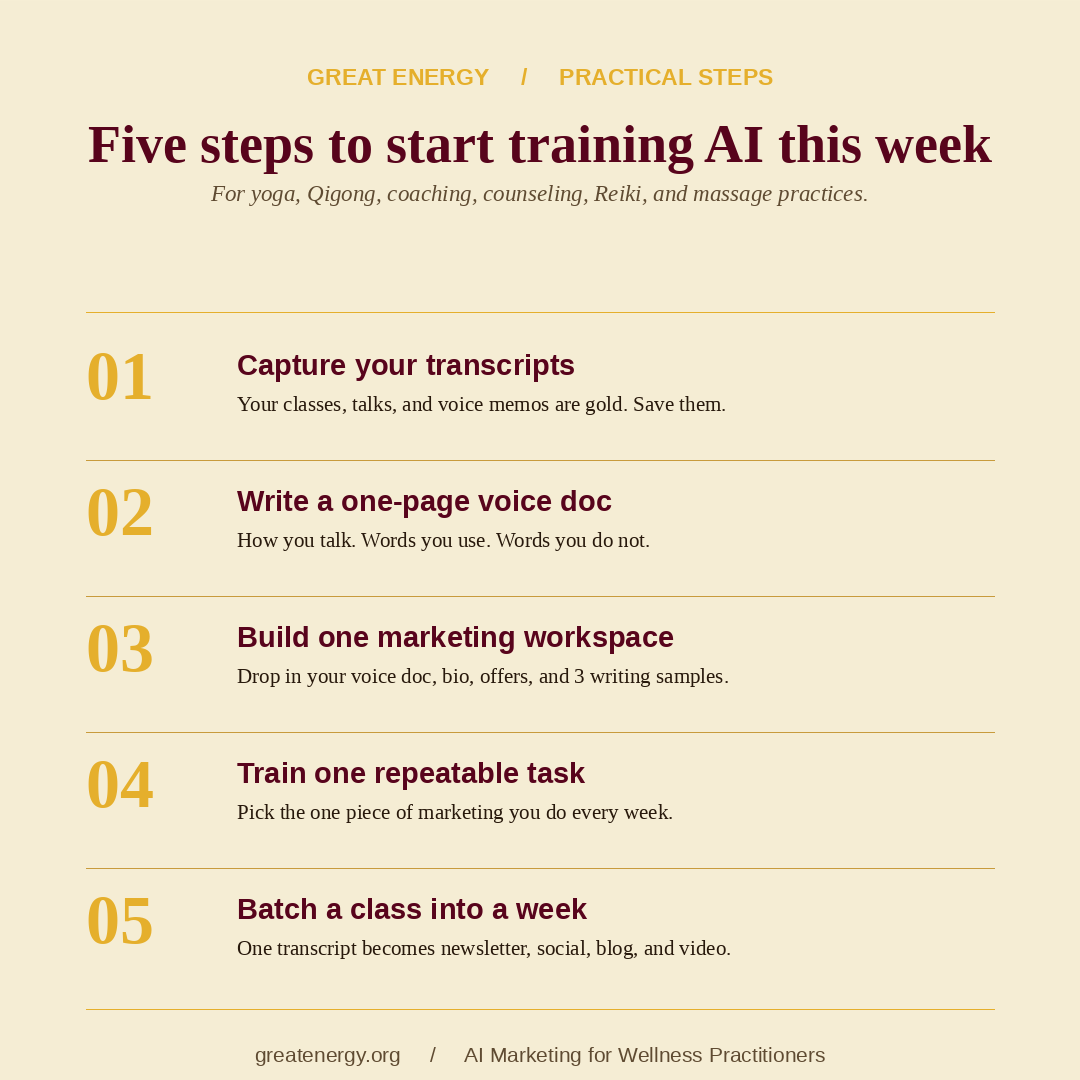
You don't have to overhaul your business. Start small. These are the five highest-leverage moves I'd recommend any wellness practitioner make first, in roughly the order to make them.
1. Start capturing your transcripts
Every class you teach, every workshop, every podcast episode, every long voice memo you record while walking. That is your gold.
Most yoga and Qigong teachers I know have hundreds of hours of teaching they treat as ephemeral. The class happens, the recording sits in a folder, nobody ever looks at it again. That's millions of words of your real voice, your real teaching, your real way of explaining things, sitting unused.
Start saving and transcribing them. Zoom does this automatically. Otter.ai, Fathom, Descript, and others do it cheaply. Whatever tool you use, just start the habit. Within a few months you'll have a private library of your own teaching that AI can pull from forever.
Translation for other practitioners:
- Coach or therapist: record your own voice memos and educational content (not client sessions, ever). Save them.
- Reiki or massage therapist: record yourself explaining the work to a friend, or capture a teaching workshop you give.
- Counselor or grief worker: record your own talks, panels, or solo voice notes about your approach.
2. Write a one-page voice document
Open a blank doc. Write down, in plain sentences, how you talk. Words you use. Words you'd never use. Phrases you say all the time. Your typical opening when you meet a new student. Your typical closing. You can type or use voice to text and just talk…
Ours has things like: "Drop into the body." "Let's get organized." "Time to tune in and tune up." "Let me just remind you what you already knew." It also has a list of words we don't use: "unlock your potential," "manifest your dreams," "step into your power."
This single document, pasted into the top of any AI conversation, will improve your output more than almost anything else.
3. Build one workspace for marketing
Pick one tool (Claude or ChatGPT, both work, we use Claude). Open a Project or Custom GPT. Name it something like "My Marketing Brain." Drop in:
Your voice document
Your bio
Your current offerings and pricing
Your ideal student description
Three or four samples of writing you're proud of (an email, a social post, a paragraph from your About page)
One transcript of a class or session that captures you at your best
Tell it: "Your job is to help me write marketing content (blog posts, emails, social posts) in my voice, for the audience and offerings described above. Always sound like the writing samples. Never invent claims I haven't made. Always ask me a clarifying question if you're not sure."
That single workspace will already produce drafts that are dramatically closer to your voice than anything you've gotten from a one-off chat.
4. Train one repeatable task before you train ten
Don't try to automate your whole business in week one. Pick one thing you do every week that you don't love. For most practitioners, the candidates are:
Writing a weekly email or newsletter
Writing social posts
Repurposing a class or session into something marketing-usable
Drafting follow-up emails to inquiries
Writing landing-page copy for a new offering
Pick one. Build a small set of instructions ("when I drop in a class transcript, pull out the three strongest teaching moments and turn each into a 100-word social post in my voice"). Run it the same way every week for a month. Tweak the instructions when something feels off.
After a month, you'll have one task in your business that takes 80% less time than it used to. After three months of doing this with three tasks, your week looks completely different.
5. Batch one class into a week of marketing
This is where it gets fun. We do this every week.
You teach one class. The class is recorded and transcribed. You drop the transcript into your trained marketing workspace. In one sitting, you ask it to pull:
The two strongest teaching moments
One paragraph that could become a blog post
Three quote-able lines for social
A short email to your list framed around the class theme
A description for the recording if you sell it
A reel or video suggestion
Twenty minutes of editing later, you have your marketing content for the week. From a class you were going to teach anyway.
This single workflow is the highest leverage thing we do at Great Energy. It's also the one most easily transferable to almost every wellness practitioner. The class, session, workshop, or talk is happening either way. Letting that one event feed your entire content week is what AI does best.
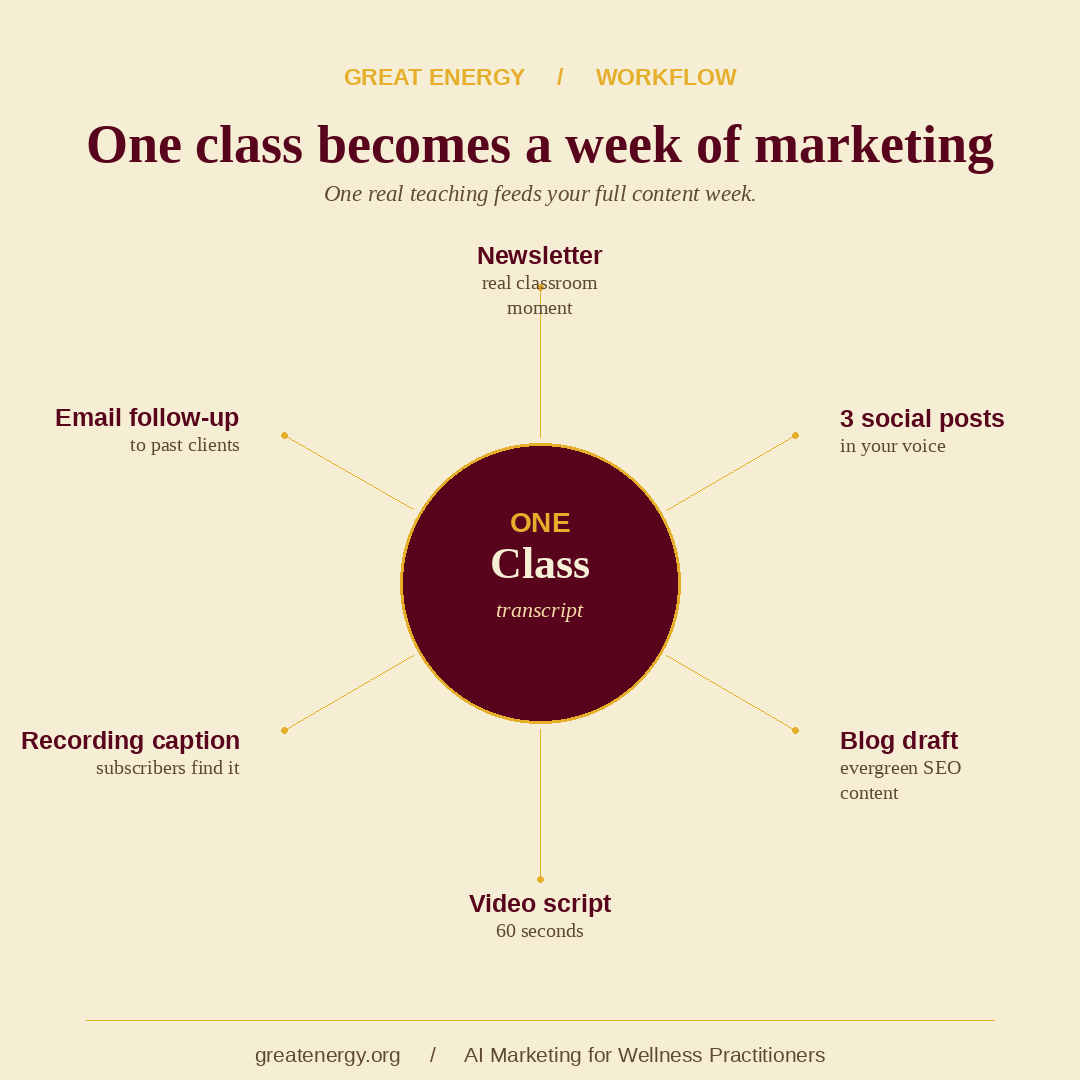
A worked example: one Qigong class becomes a week of marketing
Here's exactly how this looked at Great Energy last week. I'll show our version, then translate it into what it would look like for three other kinds of practitioner.
Our version (Qigong teacher):
I taught a 75-minute live Qigong class on grounding through the legs. The recording was automatically transcribed. I dropped the transcript into our marketing workspace and ran our content workflow. In about 25 minutes, we had:
A newsletter to our list, opening with the moment in class where a student asked, "Christopher, what do you mean let the earth catch you?" and turning my answer to her into a 400-word teaching.
Three Instagram posts pulling specific lines I'd said, each in my voice, each tied to a single image from our brand kit.
A blog draft titled The Earth Has Got Ya: What I Mean When I Say That.
A 60-second script for a short video repeat of the practice.
Timestamps for our video editor to pull out a YouTube video
A short caption for the class recording so subscribers could find it.
I edited the newsletter for about ten minutes. The rest went out almost as drafted.
For a yoga teacher:
You teach a Wednesday Vinyasa class. The theme that week is hips. Your transcript becomes a Friday newsletter on what your students felt in their hips and why, three social posts pulling your best one-liners about the hip-emotion connection, and a blog post that becomes evergreen SEO content for "yoga for hip tension."
For a massage therapist or Reiki practitioner:
You don't have to teach a class to feed the system. Record a 15-minute voice memo while walking, explaining the work you do and why it matters. Or record yourself answering the five questions new clients ask you most often. Or capture the talk you give at a wellness fair. That single recording becomes a homepage paragraph, a "what to expect" page for first-time clients, three social posts pulling your most surprising lines, an email to past clients reminding them you're there, and a script for a short intro video.
For a coach or counselor:
You record a solo voice memo (never a client session) on the topic of perfectionism, which keeps coming up in your work. Twenty minutes of voice. AI turns it into a long-form Substack post in your voice, three short LinkedIn posts, an email to your list, and a worksheet you can use as a lead magnet.
The pattern is the same in every case. One real act of teaching becomes a week of marketing in your actual voice. That's the move.
Why this matters specifically for our industry
In tech, marketing is mostly about features and benefits. Features and benefits AI can write all day, badly, and nobody really notices.
In our industry, the marketing is the teaching. Our work is voice-dependent. People follow a yoga teacher because of how she speaks to them, not because of which postures she covers. People come back to a Qigong class because of how the teacher holds the room. People hire a coach or therapist because of how they feel reading their About page.
This is exactly why we used to think AI couldn't help us. The voice is the product. AI seemed to flatten voice. So why bother?
The answer turns out to be: voice is exactly what AI can preserve, if you train it right. The teachers who lose their voice to AI are the ones who treat AI as a vending machine and accept the first draft. The teachers who keep their voice are the ones who treat AI as an apprentice, train it carefully, and edit with intention.
This is also why the lazy use of AI is so visible in our industry right now. You can spot AI-written wellness content from across the room. The em dashes. The "quiet shift happening right now." The "it's not about X, it's about Y" rhythm. The vague spiritual gloss with no actual teaching underneath. That's untrained AI. It's why your students unsubscribe.
Trained AI does the opposite. It carries your specific voice further than you could on your own.
If you're starting from zero, do these three things first
You don't need a 12-week course. You need momentum. And these tools are very easy to get going with, compared to past options.
If you only do three things this month:
Start saving your class or session transcripts. Don't process them yet. Just save them.
Write a one-page voice document. Spend an hour on it.
Open one Project in Claude or one Custom GPT in ChatGPT, drop in your voice doc, and start using it as your one marketing workspace from now on.
That's it. That's the entire starter path. Everything else builds on those three steps.
The bigger picture: where this is going
A quick note on something most wellness practitioners haven't fully clocked yet.
People have started searching for teachers, classes, and practitioners directly inside ChatGPT, Claude, Perplexity, and Google's AI Overviews, not just on Google. AI search now drives some of the highest-converting traffic on the web (NP Digital's 2025-2026 data puts the conversion rate at roughly 4.4 times traditional organic search). When someone asks ChatGPT, "who's a good Qigong teacher I can study with online?" it answers based on what it can find on the open web.
If your website is sparse, vague, or written in flat AI-slop voice, you're invisible to that whole layer of search. If your site is rich with your real teaching, structured clearly, and consistent across all your platforms, you start showing up in those answers.
This is the next chapter of marketing for our industry. The teachers who treat their website as a place to genuinely teach, in their actual voice, with depth and clarity, will be the ones AI engines recommend.
Yet again, the answer comes back to voice. Real voice, captured well, is the most valuable asset you have right now.
If you want help building this
Daniela and I do this every week for ourselves at Great Energy, and over the last year we've started doing it for a small handful of fellow teachers, coaches, and healers in our industry. We help them:
Set up their AI marketing workspace from scratch
Train it on their voice, their offerings, their teaching
Build the specific workflows that fit their practice (newsletter, social, course launches, sales pages)
Show their team how to use what we built so it lives on without us
If this gave you ideas, reach out to us on our intake form. Tell me what you'd like to take off your plate first. I write back personally and we can figure out together whether you can build it on your own from this article or whether it makes sense to work together.
The medicine you teach is real. AI doesn't have to flatten it. Trained well, it can help that medicine reach more of the people who need it.
If you build something from this, I'd love to know what you chose to automate first. Reply or email me. I'm curious.
- Christopher
Christopher Grant teaches Great Energy Qigong online and co-leads the AI and business strategy work at Great Energy. He and Daniela Hess work with teachers, coaches, and healers in the wellness industry to build AI-supported marketing systems that preserve the voice and integrity of the teaching. Learn more at greatenergy.org
Frequently Asked Questions
What does it actually mean to "train" AI instead of just "using" it?
Training AI means giving it three things before you ever ask it for output: a dedicated workspace, reference material about you and your work, and clear written instructions. Using AI means typing a prompt into a blank chat and hoping for the best. Trained AI sounds like you, knows your offerings, and gets better over time. Untrained AI sounds like everyone else.
Do I need to be technical or know how to code to do this?
No. There is no coding involved. If you can write a paragraph, organize a folder of files, and follow a few setup steps, you can train AI for your business. The tools that matter most (Claude Projects, ChatGPT Custom GPTs) are designed for non-technical users. The hard part is being clear about your voice and your offerings. The technical side is genuinely simple.
Should I use Claude or ChatGPT?
Either works for marketing. We use Claude at Great Energy because we find it stronger on tone, voice, and emotional nuance, which matters for our industry. ChatGPT is more familiar to most people and slightly easier to start with. Pick one and commit. Switching back and forth between tools will slow you down more than the differences between them help you.
Will AI make my marketing sound robotic or like everyone else's?
Only if you let it. Untrained AI produces the cold, generic content most people associate with the technology. Trained AI, given a one-page voice document and a few samples of your actual writing, produces drafts that sound dramatically closer to you. The difference is entirely in the setup. Your voice does not get lost. It gets amplified, but only if you train the tool correctly.
How long does this take to set up?
A basic, working marketing workspace takes about three to five hours over the course of one week to set up well. That includes writing your voice document, gathering your reference material, building one workspace in Claude or ChatGPT, and running a first content workflow. Going deeper (multiple workspaces, custom skills, automated tasks) takes longer. Most practitioners feel the time savings within their first two weeks.
How much does this cost?
The basic tools cost between $20 and $30 per month per user. Claude Pro is $20/month. ChatGPT Plus is $20/month. Claude's higher tiers go to $100/month for heavier use. There are no other required tools to start. Compare that to one or two hours of a copywriter or marketing assistant per month and the math is straightforward.
What about client privacy and confidentiality, especially for therapists and counselors?
Never put client session content, client names, or any identifying information into any AI tool. This is non-negotiable. AI models can be trained on inputs unless you've explicitly turned that off, and even then, the privacy guarantees are imperfect. For confidential work, only use AI for content about your own teaching, your own approach, your own marketing. Use general voice memos, public talks, or your own educational writing. Treat it like writing a blog post: only feed it what you'd be comfortable publishing publicly.
What's the first thing I should build?
A one-page voice document, then a single marketing workspace, then one repeatable workflow. In that order. Most practitioners try to build five things at once and finish none. Pick the single most repetitive marketing task you do (often a weekly newsletter or social post) and train AI to help with that one task first. Once it's reliable, add the next one.
Can AI replace my voice or my actual teaching?
No. AI can help you get more of your existing teaching to more people, but it cannot generate the teaching itself. It cannot have an original insight. It cannot sit in a class with a student and feel where the room is. It cannot do the hands-on work of healing or coaching. What it can do is take the teaching you already produce and help carry it further. The teaching is yours. The execution is what AI can take off your plate.
Will using AI hurt my SEO or make my site look spammy?
Only if the AI content is bad. Search engines and AI search engines (ChatGPT, Perplexity, Google AI Overviews) reward clear, helpful, well-structured content regardless of how it was produced. They penalize generic, low-effort content regardless of how it was produced. Trained AI content that sounds like you, answers real questions, and is well-organized helps your visibility. Untrained AI slop hurts it.
How is this different from a chatbot or a custom GPT?
A chatbot is a customer-facing tool that answers questions on your website. A custom GPT is one specific kind of trained AI, made inside ChatGPT. What we're describing in the main article is broader: a private workspace where you train AI to be your marketing collaborator. It can include a chatbot or a custom GPT as one piece, but the larger system (workspace, brain, instructions, workflows) is what produces the real time savings.
Can my team use what I build?
Yes, and they should. Once you've built a marketing workspace trained on your voice, anyone on your team can use it to produce content that sounds like you. This is one of the biggest unlocks. A new assistant or copywriter who would normally take six months to learn your voice can produce on-voice drafts on day one when they're working inside a properly trained workspace. It also means the system survives changes in your team.